



The Neo judgement: the anti-abuse provision beyond the direct parent company
CJEU 15 October 2026, C-203/25
In the NEO judgment of 15 October 2026 (C-203/25), the Court of Justice (hereinafter: the CJEU) further clarified the scope of the anti-abuse provision under the Parent-Subsidiary Directive. This judgment is relevant for the application of the withholding tax exemption in dividend tax and the non-resident corporate income tax.
What does the ruling say?
In short, the CJEU held that:
the assessment of whether an arrangement is artificial must not be confined to the economic activities of the direct dividend recipient, but must also encompass the other relevant facts and circumstances within the transaction chain;
the anti-abuse provision may also apply where the transactions deemed to be artificial take place outside the source state or where the tax advantage accrues to another participant in the transaction chain;
the requisite subjective element (the purpose of avoiding the withholding of dividend tax) need not be established at the level of the distributing subsidiary, but may also be demonstrated at the level of another group company participating in the transaction chain or of the natural person who enjoys the advantage;
correlations between dividend amounts and subsequent payments within the transaction chain may constitute indications of abuse, even where those payments are spread over a longer period.
Although the judgment concerns Lithuanian dividend distributions, it is also directly relevant to Dutch practice, in which comparable anti-abuse provisions apply. In this publication, we provide an overview of the facts, place the judgment in a broader context and set out the key points of attention for practice.
A simplified overview of the facts: from dividend to a repayment
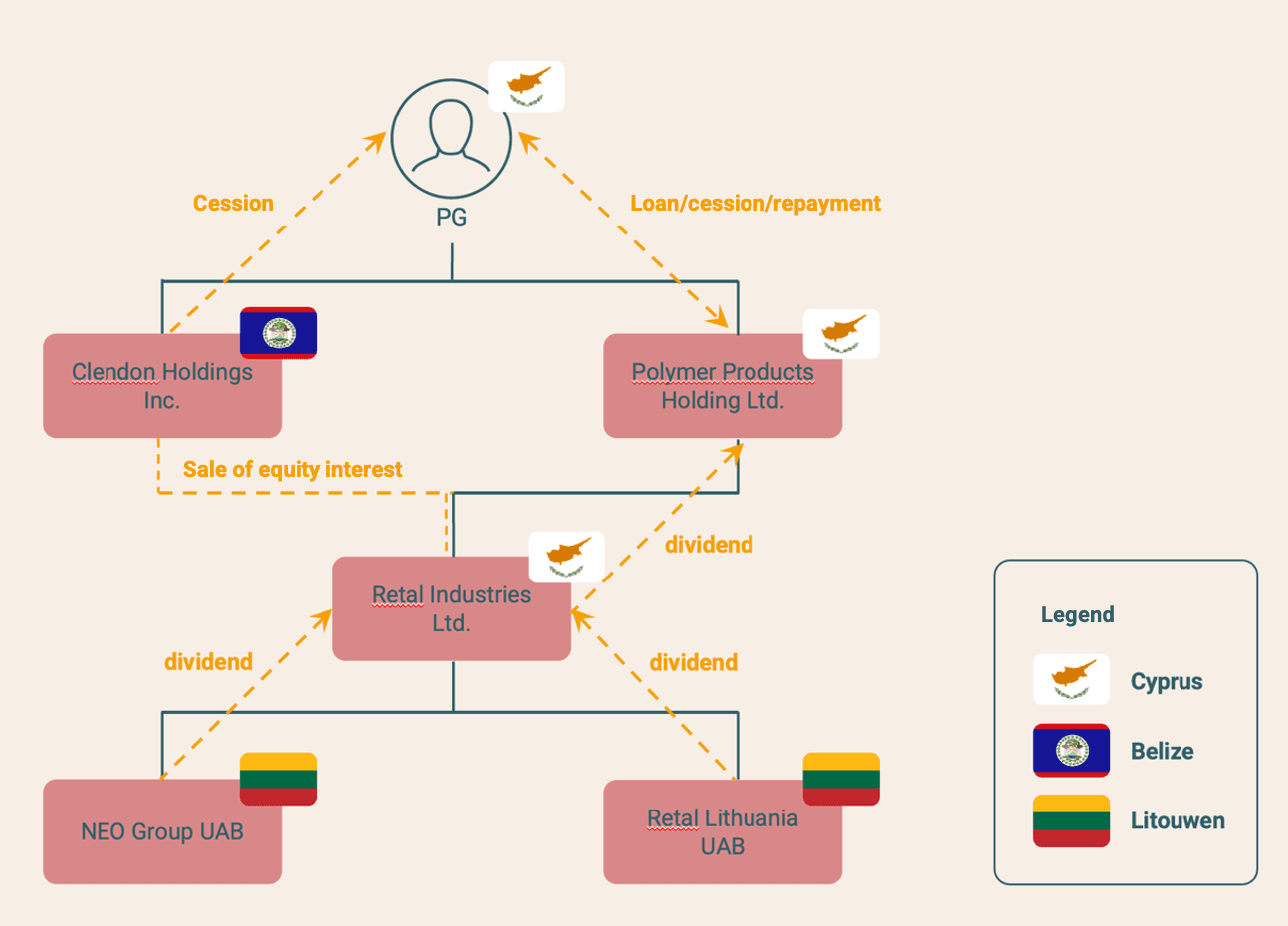
In this case, two Lithuanian companies, NEO GROUP UAB (hereinafter: NEO) and Retal Lithuania UAB, distributed a total of approximately EUR 28.5 million in dividends to their Cypriot parent company Retal Industries Ltd (hereinafter: Retal) in 2016 and 2017. The shares in Retal were initially held by a company registered in Belize. That company sold its shares to a newly incorporated Cypriot company, Polymer Products Holding Ltd (hereinafter: PPH). The purchase price of over EUR 310 million was not paid directly but remained outstanding as a debt.
The receivable arising from the purchase price was subsequently transferred to a natural person resident in Cyprus (PG), who ultimately exercised control over both the selling and the purchasing company. As a result, PPH was no longer required to pay the purchase price to the seller, but to PG.
Retal subsequently distributed dividends to PPH. PPH in turn granted loans to PG and transferred receivables to PG. The amounts thus received by PG originated from the dividends distributed by the Lithuanian companies and were used to discharge PPH's debt to PG arising from the purchase price. In this manner, the dividend distributions ultimately ended up with PG, without any dividend being distributed directly to PG.
The Lithuanian tax authorities regarded this as a chain of transactions which, in their view, constituted an artificial arrangement designed to avoid withholding tax, and imposed on NEO an additional assessment of EUR 2.25 million, plus interest and a penalty. NEO disagreed and pointed, inter alia, to the actual economic activities of Retal. The Lithuanian court subsequently referred preliminary questions to the CJEU on the scope of the anti-abuse provision.
Not the individual company, but coherence is central
One of the most important aspects of the judgment is that the CJEU confirms that the presence of economic activities at the level of the direct parent company does not preclude the application of the anti-abuse provision. The provision is therefore not limited to arrangements in which an intermediary conduit company is interposed within the structure. Even where only certain steps within a structure are artificial, the anti-abuse provision may apply.
The assessment may therefore not focus exclusively on the position of the direct dividend recipient. Transactions at higher levels, such as share transfers, the conclusion of loan agreements and the assignment of receivables, may also be considered. The elements to be assessed as identified by the CJEU are, however, non-exhaustive, which raises the question of what else may fall within the scope of the assessment framework.
Cross-border investigation and the location of tax advantage
The CJEU held that the investigation into abuse must not be confined to the Member State from which the dividend originates. The tax authorities must conduct a comprehensive investigation that also encompasses transactions carried out before or after the distribution of dividends outside that Member State. In that regard, the tax advantage need not have been obtained by the distributing subsidiary itself. A tax advantage accruing to a natural person who exercises control over the group may also be relevant, regardless of the stage of the transaction chain at which that advantage is obtained. The CJEU considered that such a cross-border analysis does not conflict with the principle of proportionality, but is in fact necessary for combating arrangements which can only be established as constituting abuse after such an analysis.
What do the cash flows reveal about potential abuse?
The dividends distributed by the Lithuanian companies were comparable in magnitude to the amounts that ultimately ended up with the natural person. The CJEU regards this as an indication of abuse, but such comparability is insufficient to give rise to a general presumption of abuse. A national court may take that comparability into account as an indication, but an objective analysis of all relevant facts and circumstances remains necessary.
The CJEU also considers the time elapsed between transactions to be relevant as an indication of the existence of abuse, but it is not a requirement for abuse that dividends received are passed on within a short period of time. Transactions that take place over a longer period may also form part of an artificial arrangement and serve as an indication of abuse. The tax authorities may therefore not be required to confine the investigation to a short period surrounding the dividend distribution, but must take into account all elements that play a role in establishing abuse.
Knowledge of the distributing company is not a requirement
The CJEU further clarified that the distributing subsidiary need not itself have been aware of the artificial arrangement. As regards the subjective element of abuse, it suffices that it is demonstrated, in respect of at least one of the group companies involved or the natural person who ultimately enjoys the advantage, that that entity had, or could have had, the intention of obtaining an advantage flowing from EU law by artificially creating the conditions for that advantage. It is therefore not required that the subsidiary itself was aware of that intention. The burden of proof as regards the existence of abuse remains with the tax authorities.
Placing the judgement in a broader context
The NEO judgment fits within the development of European case law in which increasing weight is attached to the economic reality behind legal structures and transactions. Whereas the Danish cases (T Danmark and Y Denmark) primarily concerned the use of conduit companies, the NEO judgment confirms that the anti-abuse provision is not limited to such situations. The line of reasoning from the Nordcurrent judgment, that the assessment must not be confined to a single point in time, also recurs: an arrangement that was initially established for valid commercial reasons may change in character and be regarded as artificial at a later stage. In addition, the CJEU emphasizes that bilateral tax treaties, even where they are based on the OECD Model Convention, cannot be relied upon to achieve a result that is contrary to EU law. The fact that a company qualifies as the "beneficial owner" within the meaning of such a treaty does not, therefore, mean that the withholding tax exemption automatically applies.
For the Netherlands, this is particularly relevant in relation to the application of the withholding tax exemption in dividend tax. In the anti-abuse provision of Article 4(3)(c) of the Dividend Tax Act 1965, commercial reasons and economic reality play an important role. The judgment provides points of reference for the assessment of international holding structures in which dividend distributions coincide with other transactions within the group. The same applies to the non-resident tax liability in corporate income tax.
Practical guidance
The judgement gives rise to several important points of attention for practice:
firstly, it is not sufficient to establish solely that the direct parent company carries on actual economic activities. The commercial rationale for transactions at other levels within the structure may also be relevant;
secondly, cash flows that correspond in terms of magnitude or timing merit particular attention. This applies, for example, where dividend distributions are followed by loans, set-offs or other transfers of assets to the ultimate shareholder;
thirdly, it is advisable not only to consider the legal form chosen, but also to carefully document the commercial reasons for the individual transactions and their interrelationship;
fourthly, qualification as a "beneficial owner" under a tax treaty does not provide automatic protection against the application of the anti-abuse provision;
fifthly, it is recommended that existing structures continue to be tested against changed circumstances, as the CJEU, in line with the Nordcurrent judgment, confirms that an arrangement initially justified by commercial reasons may be regarded as artificial if it is subsequently maintained without valid commercial reasons continuing to exist.
Conclusion
The NEO judgment makes clear that the investigation into anti-abuse does not end with the company that receives the dividend. The manner in which the distributed funds are subsequently deployed within the structure may also be relevant for the anti-abuse provision. The judgment provides tax authorities with the scope, and imposes on them the obligation, to investigate the coherence between various transactions, including outside their own jurisdiction. For internationally operating enterprises, it is therefore important that not only the structure itself, but also the commercial motives for changes and transactions within that structure, can be sufficiently substantiated.
The judgment does, however, also leave a number of important questions unanswered. What significance, for example, should be attached to the specific transactions in this case, and would the outcome have been different if, at the level of the ultimate shareholder, irrespective of the various transactions, no tax claim existed? Furthermore, it remains unclear how far the source state must and may go in assessing alleged abuse abroad, and how corrections by multiple Member States should be dealt with. The question also remains how the judgment is to be applied where the tax avoided is levied not in an EU Member State, but in a third country.
If you have any questions about the implications of this judgment for your structure, or about other developments in the field of dividend tax and corporate income tax, please do not hesitate to contact the specialists at HVK Stevens.